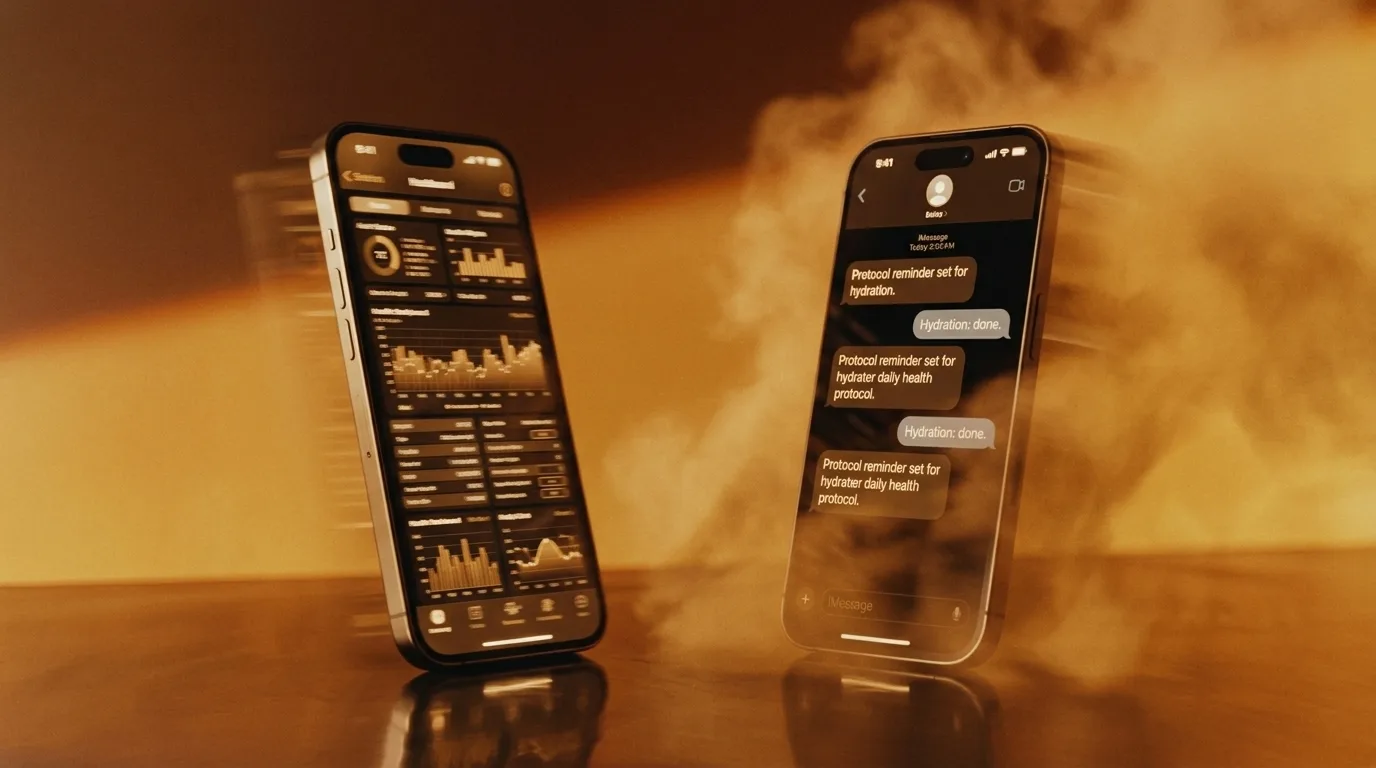

System Labs vs automated protocol management
High-performing biohackers and healthmaxxers frequently encounter a major bottleneck in personal optimization. Managing modern protocols, from advanced peptide cycles to longevity stacks, often feels like a second full-time job. Traditional digital health platforms like System Labs emphasize manual lab telemetry and clinical intake, presenting users with dense reports and portal interfaces. The alternative approach is active health automation: an always-on assistant for your biology that converts complex health variables into daily momentum.
The Shift from Passive Dashboards to Proactive Automation
Telehealth and lab portals provide valuable access to diagnostic markers, but they leave the operational burden squarely on the user. Reviewing biomarker charts does not resolve the logistical challenge of remembering precise reconstitution schedules, calculating titrations, or aligning daily workouts with physiological recovery. This creates a clear division between passive tracking portals that record telemetry and proactive personal health assistant platforms that take action.
| Capability Dimension | System Labs Model | Automated Assistant Model |
|---|---|---|
| Interface Model | Web portal and standalone clinical dashboard | Conversational iMessage and WhatsApp native |
| Primary Function | Lab telemetry logging and product ordering | Agentic protocol execution and daily health logistics |
| Daily Task Management | Manual calendar logging and self-directed adherence | Proactive reminders, class bookings, and automated adjustments |
| Biometric Integration | Static lab reports and episodic telemetry | Continuous real-time wearable telemetry (WHOOP, Oura, Apple Health) |
When evaluating platforms for longevity stacks and peptide regimens, the distinction comes down to workflow architecture. A portal delivers data points, whereas an automated assistant handles the heavy lifting of daily execution.
System Labs alternative
Dedicated health optimizers exploring an alternative to System Labs typically share a common frustration: data fragmentation. System Labs sells clinician-guided NAD+ and peptide programs through a web intake and portal flow, but the offering stops at the delivery step. Once the vial arrives at the doorstep, the platform offers no real-time guidance on sleep adjustments, injection timing, or compounding variables.
Eliminating the Overhead of Standalone Portals
Navigating separate portals for lab orders, spreadsheets for dose tracking, and isolated wearable apps creates tracking exhaustion. Healthmaxxers do not need another dashboard full of numbers they must manually interpret every evening. They need an integrated operational layer that connects clinician-approved protocols directly into daily life without requiring constant logins or manual form filling.
- Lack of conversational friction removal: Logging into web portals to check dosing notes breaks daily workflow.
- Absence of real-time bio-data feedback: Traditional telehealth interfaces do not adapt daily routines to fluctuating HRV or sleep strain.
- Isolated protocol logistics: Meal planning, recovery sessions, and supplement scheduling remain completely disconnected from clinical regimens.
Shifting to a conversational automation model eliminates this manual logging tax. Instead of maintaining spreadsheets, users interact with a responsive agent that executes protocol logistics in the background, making health maintenance effortless.
health protocol management
Running complex regimens involving peptides, GLP-1 agonists, or mitochondrial cofactors introduces significant cognitive overhead. Managing multiple variables, such as reconstitution volume, half-life decay curves, timing relative to meals, and hydration requirements, demands continuous mental tracking. When individuals must manually manage every detail, protocol fatigue rapidly accumulates.
Why Willpower Fails Complex Regimens
Protocol failure is rarely a lack of discipline; it is an architectural flaw in manual health management. A real-world claims analysis of 4,066 commercially insured adults without diabetes who newly initiated GLP-1 therapy for obesity found that only 27.2% were adherent over the first year, with average proportion of days covered of 51.0% and 1-year persistence of just 32.3%. When adherence depends on daily manual willpower, noisy dashboards, and manual tracking apps, drop-off becomes inevitable.
- Reconstitution and dosage friction: Calculating unit equivalents across varying syringe volumes leads to hesitation or skipped doses.
- Timing mismanagement: Forgetting half-life intervals undermines steady-state peptide concentrations.
- Unmonitored physiological stress: Failing to adjust training volume during metabolic shifts increases fatigue and lean mass loss.
Biohackers seeking sustainable compounding results require automated systems that remove the willpower requirement. Agentic tracking ensures every dose and lifestyle variable stays aligned without forcing the user to micro-manage daily calculations.
automated health assistant
The fundamental evolution in digital wellness is moving away from dedicated apps toward conversational agents that operate where users already communicate. Rather than opening standalone peptide tracker apps that demand manual data entry, an agentic assistant lives directly inside everyday messaging channels like iMessage and WhatsApp.
Frictionless Interaction via Natural Conversation
Interacting with a health assistant via text transforms adherence into a low-friction habit. Users receive timely, context-aware reminders for their protocol doses, confirm completion with a single tap or text response, and log transient symptoms effortlessly. There is no software to navigate, no password to remember, and no complex table to update.
- Natural language logging: Texting completed doses logs events instantly without navigating submenus.
- Dynamic schedule shifts: Notifying the assistant of schedule delays automatically reschedules dependent protocol steps.
- Zero app fatigue: Eliminates the clutter of standalone tracking apps while keeping communication fast and seamless.
By removing the friction of manual app navigation, conversational automation protects focus and energy. Protocol adherence shifts from a demanding chore into an effortless, ambient background process.
Unifying siloed wearable data
Wearable adoption has surged across the population, providing an unprecedented stream of biometric telemetry. Reporting on Health Information National Trends Survey data, the NIH’s National Heart, Lung, and Blood Institute notes that almost one in three Americans uses a wearable device, such as a smart watch or band, to track their health and fitness, and that more than 80% of those users would share the data with their doctor. However, for most biohackers, this continuous telemetry remains locked inside proprietary silos.
Connecting Telemetry to Clinical Protocols
A WHOOP band calculates daily strain and HRV; an Oura ring monitors nocturnal recovery and body temperature; Apple Health aggregates daily movement and resting heart rate. In isolation, these numbers offer passive insights but zero automated action. When wearable metrics sit separate from your peptide or supplement protocol, you miss critical signals, such as an elevated resting heart rate signaling systemic fatigue or depressed HRV indicating inadequate recovery.
| Biometric Signal | Fragmented Silo Behavior | Unified Protocol Intelligence |
|---|---|---|
| HRV Suppression | Shows a recovery score on a standalone phone screen | Automatically dials back workout intensity and schedules extra recovery sleep |
| Elevated Resting Heart Rate | Logs an alert in a wearable app history tab | Flags potential protocol stress and prompts hydration and electrolyte adjustments |
| Sleep Architecture Deficits | Displays fragmented REM and Deep sleep stages | Adjusts evening routine timing and optimizes supplement schedules |
Unifying wearable telemetry into a cohesive optimization layer turns passive biometric data into actionable context. Your health protocol adapts dynamically to your biological readiness rather than following a rigid, uncalibrated schedule.
Executing the daily routine
The ultimate promise of health automation is moving beyond analysis into real-world execution. Everyday decision load is far heavier than most people realise. In research by Cornell’s Brian Wansink and Jeffery Sobal, 139 people underestimated how many food-related decisions they made each day by an average of more than 221 decisions. Adding dozens of manual fitness, nutrition, and protocol decisions on top creates severe decision fatigue that degrades consistency.
From Static Recommendations to Automated Action
Rather than delivering another checklist of recommendations that you must manually execute, an agentic system takes direct physical action. If your recovery telemetry indicates peak readiness, the system can automatically book a high-intensity session through ClassPass as soon as a preferred spot opens. If your biometric strain is high, it automatically switches your booking to restorative mobility work and adjusts your daily meal choices to hit target macronutrients without guesswork.
- Biometric reading: The system analyzes morning HRV, sleep metrics, and recovery telemetry from your connected wearables.
- Protocol calibration: Training strain, nutrition targets, and hydration goals are adjusted in real time based on physical readiness.
- Logistical execution: Class reservations are booked, calendar slots are protected, and macro-aligned meals are organized automatically.
Putting daily logistics on autopilot eliminates the friction between knowing what to do and actually doing it. Consistency happens naturally because the system handles the heavy lifting.
miora Protocol concierge
For biohackers, healthmaxxers, and individuals running advanced peptide or GLP-1 regimens, miora Protocol delivers a comprehensive, closed-loop concierge experience. Developed by Reina Health, Inc., it operates as a guided wellness assistant that combines clinician-backed protocol design, wearable integration, and proactive adherence tracking natively via iMessage and RCS.
Protecting Muscle, Energy, and Drive
Complex protocols require continuous oversight to protect lean muscle mass, optimize energy levels, and sustain metabolic drive. Through daily conversational check-ins, the Protocol keeps clinicians in the loop while monitoring your biometrics 24/7. It tracks side-effect variables, manages dosing schedules, and ensures your nutrition and training support your longevity goals. While it serves as an intelligent wellness assistant and does not replace professional medical advice, it provides the operational structure necessary for lasting protocol success.
- Dedicated protocol guidance: Access to experienced specialists and clinician-designed frameworks via text.
- Closed-loop wearable telemetry: Seamless integration with WHOOP, Oura, Garmin, and Apple Health.
- Proactive adherence tracking: Intelligent conversational prompts that keep your peptide or GLP-1 stack consistent.
- Effortless health logistics: Automated class bookings, schedule optimizations, and macro alignment without manual tracking apps.
Health optimization should not require endless manual tasks or noisy dashboards. With a conversational concierge layer handling execution, you replace tracking exhaustion with proactive action, keeping your body’s wisdom and health goals perfectly aligned.