
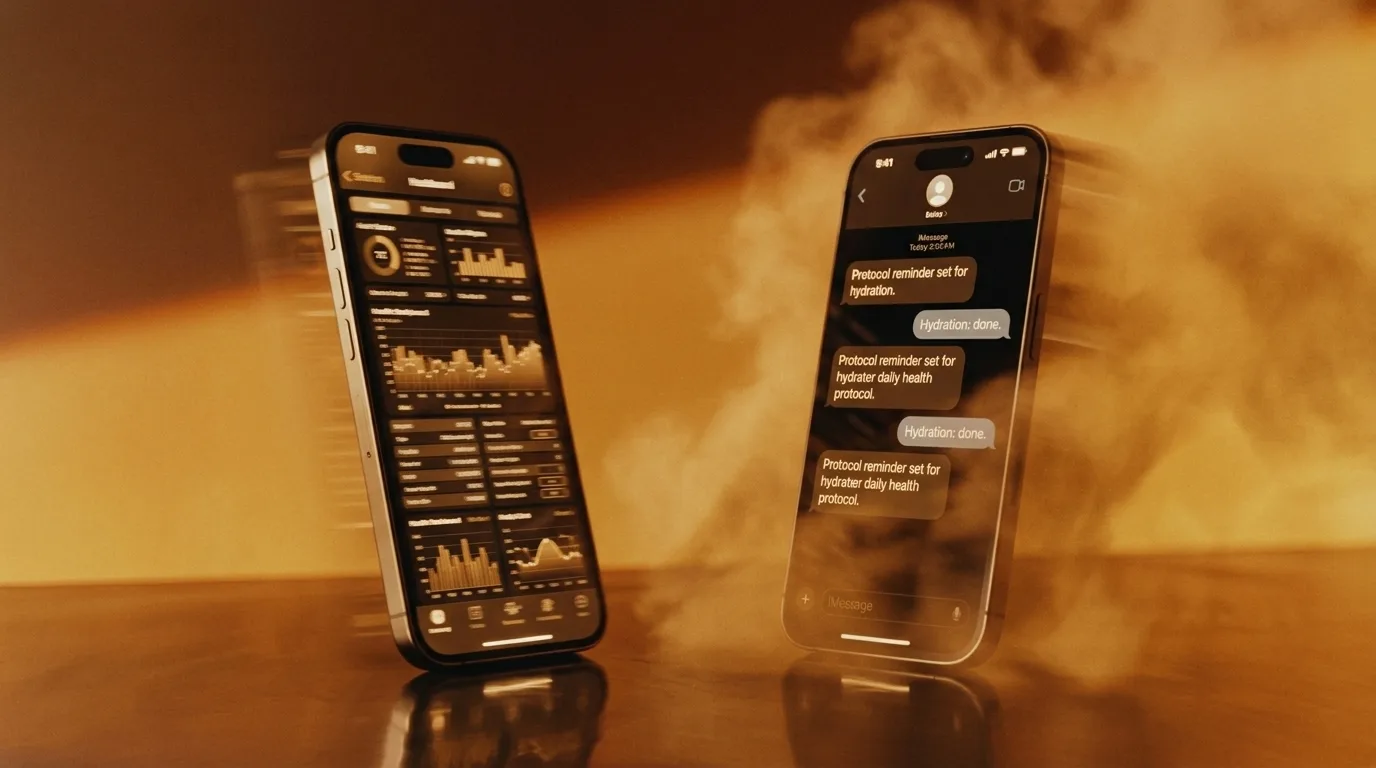
The Protocole vs conversational health agents
Managing an advanced longevity stack demands precision. When your daily routine spans peptide cycles, targeted micronutrients, morning light protocols, and zone-2 cardio, tracking every variable quickly turns into a labor-intensive chore. As healthmaxxers and biohackers push for higher baseline performance, software tools have split into two distinct philosophies: standalone manual routine managers versus conversational health automation.
The Protocole represents the dedicated app approach, offering a structured interface where users manually configure routines, schedule compounds, and log completed doses through daily check-ins. It organizes your schedule neatly, but it still requires continuous manual input and app navigation. The conversational approach removes standalone app friction entirely by operating as an agentic personal health assistant natively inside iMessage and RCS, connecting wearable telemetry directly to your daily routine without manual logging.
| Dimension | The Protocole | Conversational AI agent |
|---|---|---|
| Interface Type | Standalone native mobile app | Conversational AI (iMessage & RCS) |
| Data Entry Model | Manual self-reporting & button taps | Automated wearable sync & natural text replies |
| Telemetry Ingestion | Isolated to logged app check-ins | Continuous background sync (WHOOP, Oura, Apple Health) |
| Adherence Driver | Push notifications prompting app opens | Proactive two-way conversational check-ins |
| Action Capability | Static schedule tracking | Active execution and protocol adjustments |
A scoping review of 18 studies with a combined 525,824 participants found that a median of 70% of people abandon lifestyle and mental health apps within the first 100 days, with poor user experience and content burden among the recurring reasons. For longevity enthusiasts comparing modern biohacking apps, the core difference comes down to execution: whether you want another dashboard requiring manual upkeep, or an intelligent assistant that runs your protocol in the background.
The Protocole review
The Protocole delivers a structured, visually polished environment for biohackers managing multi-compound stacks. Its interface stands out with an interactive 3D body map designed for logging subcutaneous and intramuscular injection sites, paired with a catalog of 81 compounds spanning longevity peptides, bioregulators, and metabolic agents. For users who want a dedicated visual ledger to catalog schedules and review historical cycles, it provides a clean, organized framework.
The Friction of Manual Dashboards
Where standalone routine managers run into friction is the sustained cognitive burden of manual entry. To maintain an accurate record, you have to unlock your phone, open an isolated dashboard, select compounds, and log dosages every single day. Industry benchmarks show that health and fitness app activation falls from 26% on day one to 10% by day 28, and demanding data entry ranks as the most common reason people abandon a health app altogether.
- Visual stack architecture: Comprehensive compound libraries and 3D site mapping create a structured initial setup for cycle planning.
- Manual entry overhead: Maintaining consistency requires opening a standalone application multiple times daily, turning routine management into another administrative chore.
- Siloed context: Wearable recovery telemetry and sleep metrics remain separate from daily dose logs unless manually cross-referenced.
While The Protocole works well as a visual catalog for peptide protocol organization, real-world consistency breaks down when tracking feels like a chore. Rather than forcing you into another app dashboard, conversational assistants shift routine tracking to native messaging, capturing data and wearable context seamlessly in the background.
biohacking routine manager
Managing a high-performance protocol requires balancing dozens of moving variables: timing peptide reconstitution, tracking supplement cycles, interpreting morning HRV telemetry, and adjusting training strain. When health optimizers attempt to run these complex stacks manually, the cognitive overhead turns daily routine maintenance into a tedious chore. Decision fatigue compounds rapidly across the day, draining the mental energy needed for high-leverage work.
Research from Cornell University demonstrates that people make an average of 221 decisions daily regarding nutrition alone. When you layer on peptide timing, recovery windows, macro targets, and sleep optimization protocols, the cognitive load easily exceeds 50 distinct micro-decisions each day. Without automated systems doing the heavy lifting, this friction leads directly to missed doses, abandoned protocols, and tracking burnout.
The Friction of Manual Health Logistics
- Fragmented data silos: Wearable telemetry from WHOOP, Oura, or Apple Health sits isolated from supplement and peptide logs.
- Cognitive overload: Calculating daily timing, dose schedules, and recovery interventions on the fly drains daily focus.
- Interface fatigue: Opening standalone tracker apps multiple times a day creates friction, leading to protocol drift.
This cognitive friction explains why health optimizers are shifting away from passive trackers toward active execution to run their daily health routine. Instead of forcing you to navigate noisy dashboards and manually log every step, an agentic routine manager handles the operational burden in the background, keeping protocols aligned with real-time biometric readiness without the daily willpower tax.
protocol tracking app
Setting up a dedicated protocol tracking app seems straightforward at first: you configure compound schedules, dial in units, and establish push notifications. Yet standalone mobile utilities treat protocol tracking as an isolated data-entry chore rather than an integrated loop. When you manage complex longevity stacks, logging every variable across isolated screens quickly turns daily health optimization into a tedious second job.
The Friction of Manual Entry and the 100-Day Drop-Off
Maintaining consistent logs inside a standalone tracking app requires constant cognitive effort. A scoping review published in the Journal of Medical Internet Research found that a median of 70% of users discontinue mobile health app use within the first 100 days, with technical issues, poor user experience, and the time cost of app upkeep among the 22 reasons users gave. Without live feedback loops tied to biological data, logging consistency drops off quickly.
- Unrecorded timing shifts: Missing exact administration times obscures pharmacokinetic half-life curves and protocol timing.
- Biometric isolation: Failing to connect dosing schedules with real-time HRV, sleep stages, and recovery telemetry from wearables.
- Manual entry drop-off: Skipping consecutive entries during travel or hectic workdays, leaving protocol data fragmented.
When protocols rely entirely on static checklists, adherence becomes a fragile willpower test. Rather than forcing you to open a dashboard every day, modern setups shift away from manual entry toward proactive systems that capture data and automate daily decisions without friction.
Wearable Telemetry vs Manual Entry
Manual logging turns protocol management into an exhausting second job. Dedicated routine managers like The Protocole rely on self-reported inputs, asking you to open an app, navigate screens, and manually log your sleep, workouts, and stack adherence. Over time, that manual friction leads directly to decision fatigue and abandoned records. Digital health researchers draw the same distinction: active sensing requires participant engagement and runs into burden and compliance problems, while passive sensing continuously collects objective data such as heart rate and sleep through devices without requiring ongoing attention.
Closing the Loop from Biometrics to Action
A conversational agent can replace manual check-ins with effortless background data synchronization. Your WHOOP tracks HRV and daily strain, your Oura ring measures recovery metrics, and Apple Health data aggregates baseline physiological variables. Instead of leaving these metrics sitting in fragmented silos, the assistant continuously ingests the telemetry stream. When your recovery score drops or sleep efficiency takes a hit, it proactively recalibrates your training schedule and recovery protocols for the day before you even think to check a dashboard.
| Protocol Parameter | Manual Check-In Apps | Conversational Agents (Passive Telemetry) |
|---|---|---|
| Biometric Sync | Requires manual input or static exports | Continuous background pull from WHOOP, Oura, and Garmin |
| Protocol Adjustments | Static schedules adjusted by the user | Dynamic updates to training and recovery in real time |
| Interface Friction | Multiple app taps and dashboard clutter | Zero-app conversational interaction via text |
This shift from manual tracking to true health automation protects your time, mental bandwidth, and physical output. You get the benefits of an adaptive, data-driven protocol without the cognitive overhead of maintaining it.
Overcoming Decision Fatigue in Longevity Stacks
Relying on willpower to maintain an advanced longevity stack is a fundamental design flaw. When managing complex supplement timing, peptide cycles, and recovery variables becomes a second full-time job, cognitive overload inevitably forces regression toward convenience. Cornell researchers documented that people make an average of 221 food-related decisions every day alone. Layering manual protocol logging on top of existing baseline fatigue rapidly drains executive function before midday.
Why Manual Logging Fails Complex Stacks
Traditional routine apps demand constant manual logging, dashboard navigation, and mental reconciliation of conflicting telemetry. When biohackers have to interpret recovery scores manually and recalibrate training volume themselves, protocol adherence collapses under decision fatigue. Disconnected metric silos like sleep stages and strain scores simply accumulate without translating into proactive adjustments.
- Manual tracking: requires active dashboard check-ins, manual dose inputs, and mental strain to align recovery scores with daily habits.
- Agentic execution: leverages health automation to ingest biometric telemetry in the background and proactively suggest protocol modifications.
- Compounding consistency: removes daily cognitive friction so your stack runs smoothly without relying on fleeting motivation.
Shifting from manual check-in apps to conversational agents transforms protocol management into an effortless background process. Instead of demanding constant focus, an agent working through iMessage and RCS handles the logistical heavy lifting, keeping your health protocols consistent without adding to your daily decision fatigue.
miora: The Zero-Friction iMessage Health Agent
While dedicated tracking applications require manual check-ins and noisy dashboards, a conversational agent eliminates friction by living directly inside iMessage and WhatsApp as an agentic health concierge. Meeting optimizers where they already communicate removes the cognitive load of opening separate apps. A narrative review of 162 studies on text message reminders in health care found that adherence outcomes improved in the large majority of SMS reminder interventions, which is why lightweight conversational contact tends to outperform isolated software portals.
Automating Stack Logistics by Text
For individuals managing peptide cycles, GLP-1 regimens, or longevity stacks, this model delivers concierge support with clinicians in the loop. Instead of turning daily tracking into a second full-time job, the assistant pulls real-time biometrics from WHOOP, Oura, and Apple Health, translating raw telemetry into actionable adjustments. As a wellness assistant, it handles the heavy lifting of tracking while explicitly complementing your primary clinical care.
- Conversational data logging: Log doses, energy levels, and subjective feedback in plain text without navigating complex submenus.
- Automated biometric context: Pairs daily check-ins with passive HRV, sleep, and recovery metrics to spot strain trends.
- Clinical concierge support: Access expert specialist input via text to troubleshoot timing, hydration, or macro intake.
- Proactive execution: Adjusts daily recommendations dynamically based on wearable recovery scores.
For biohackers seeking structured stack management without tracking fatigue, shifting from manual peptide tracker apps to proactive automation creates effortless consistency. Text miora to streamline your protocol and put your daily health logistics on autopilot.