System Labs health tracking
Managing an advanced longevity regimen often begins with structured medical oversight and biomarker discovery. Modern telehealth providers have built structured digital infrastructure to expand access to wellness compounds, hormone optimization, and specialized longevity therapies. In an independent review of telehealth access, Care Path Compare details how System Labs operates as a cash-pay platform connecting patients to licensed clinicians, baseline blood tests, and fulfillment pharmacies. This setup provides a formal clinical entry point for individuals seeking targeted wellness support.
The standard process begins with an asynchronous medical intake where patients submit health information for review. A clinician reviews that submission, decides whether prescribing is appropriate, and may request additional records or baseline laboratory testing that patients complete at an outside laboratory. When treatment is prescribed, the medication may be prepared and shipped with supplies where applicable. This model establishes clear clinical oversight and steady fulfillment.
The limitations of static progress logs
While telehealth intake portals excel at clinical clearance and fulfillment logistics, day-to-day protocol management often relies on static digital portals. Patients receive their therapies alongside static documentation and digital intake summaries, but tracking daily biological responses remains entirely manual. When managing peptide cycles or metabolic therapies, logging daily injection schedules, subjective side effects, and biometric shifts inside a browser portal creates persistent operational friction.
- Initial intake collects historical health markers, but does not capture dynamic day-to-day recovery shifts.
- Baseline blood panels confirm candidate eligibility without automating daily protocol execution.
- Web-based portals store treatment summaries, but leave daily adherence and timing to memory or external spreadsheets.
- Refill schedules run on calendar billing cycles rather than responding dynamically to individual lifestyle variables.
System Labs software
The software experience for telehealth platforms like System Labs is structured primarily around account management, prescription coordination, and support requests. Several treatments are sold on an automatic-refill subscription, and subscribers typically pause or cancel by contacting support rather than through a self-service clinical workflow. For individuals navigating straightforward monthly regimens, this administrative setup works reliably.
However, biohackers and healthmaxxers managing sophisticated stacks face a different challenge. The portal serves as a passive repository of medical records rather than an intelligent partner in execution. Users must log into a desktop or mobile browser, navigate between disjointed tabs, and manually cross-reference their dosing calendars against wearable readiness scores or daily schedules. The software presents your data, but it does not synthesize it into actionable decisions.
The user’s role in synthesizing protocol variables
Because traditional telehealth software is built around transactional prescribing rather than daily wellness execution, the cognitive burden of synthesizing data falls squarely on the individual. If your sleep quality drops or your resting heart rate elevates following a dose adjustment, the software does not flag the interaction or adjust your training intensity. You are forced to act as your own data analyst, piecing together information from disparate apps to figure out how to structure your day.
| Portal Feature | System Labs Software Workflow | Operational Friction |
|---|---|---|
| Intake & Clearance | Asynchronous medical review of an online intake form | Isolated from daily wearable biometric data |
| Prescription Tracking | Automatic refills on a recurring billing and shipping cycle | Requires manual calendar reminders for daily timing |
| Biomarker Reports | Baseline lab testing completed at an outside laboratory | No automated translation into daily nutrition or recovery habits |
| Clinician Communication | Cancellations and questions handled by contacting support | Lacks real-time conversational workflow inside standard messaging apps |
The cognitive cost of manual dashboards
High-performing individuals often treat health optimization like a rigorous engineering project. They wear biometric rings, track blood glucose, log macronutrients, and monitor peptide cycles across multiple specialized apps. While the intention is peak performance, the reality is tracking exhaustion. Managing five different health dashboards turns wellness into a second full-time job, cluttering daily routines with constant data entry, manual cross-checks, and persistent cognitive friction.
Every manual data entry point demands finite willpower. A concept analysis of decision fatigue published in the journal Nursing Research cites the estimate that an American adult makes roughly 35,000 decisions a day, and notes that repeated acts of decision-making impair the quality of subsequent choices. When you are forced to decide whether your morning heart rate variability warrants a lighter training session, calculate remaining protein targets, and remember peptide reconstitution timings, decision fatigue sets in. By evening, cognitive depletion pushes people away from their optimal health protocols toward low-effort defaults.
Understanding tracking exhaustion and app abandonment
This cognitive friction explains why traditional digital health tools suffer from severe drop-off rates. A scoping review of 18 studies covering 525,824 participants, published in the Journal of Medical Internet Research, found that a median of 70% of users discontinued app use within the first 100 days. The reasons the authors identified fall into six categories: technical and functional issues, privacy concerns, poor user experience, content and features, time and financial costs, and evolving user needs and goals.
- Phase 1: High initial motivation leads to downloading separate apps for food logging, wearable telemetry, and protocol schedules.
- Phase 2: Data silos emerge as users struggle to manually connect heart rate data, blood markers, and dosing logs across fragmented tools.
- Phase 3: Decision fatigue accumulates from logging dozens of daily micro-variables into static dashboards.
- Phase 4: Tracking burnout sets in, and most users have walked away from their logging tools within the first 100 days.
The takeaway for healthmaxxers is clear: manual logging dashboards do not create long-term adherence. To sustain complex longevity stacks and protect your energy, the entire tracking paradigm must shift from passive manual entry to intelligent health automation.
Conversational protocol tracking
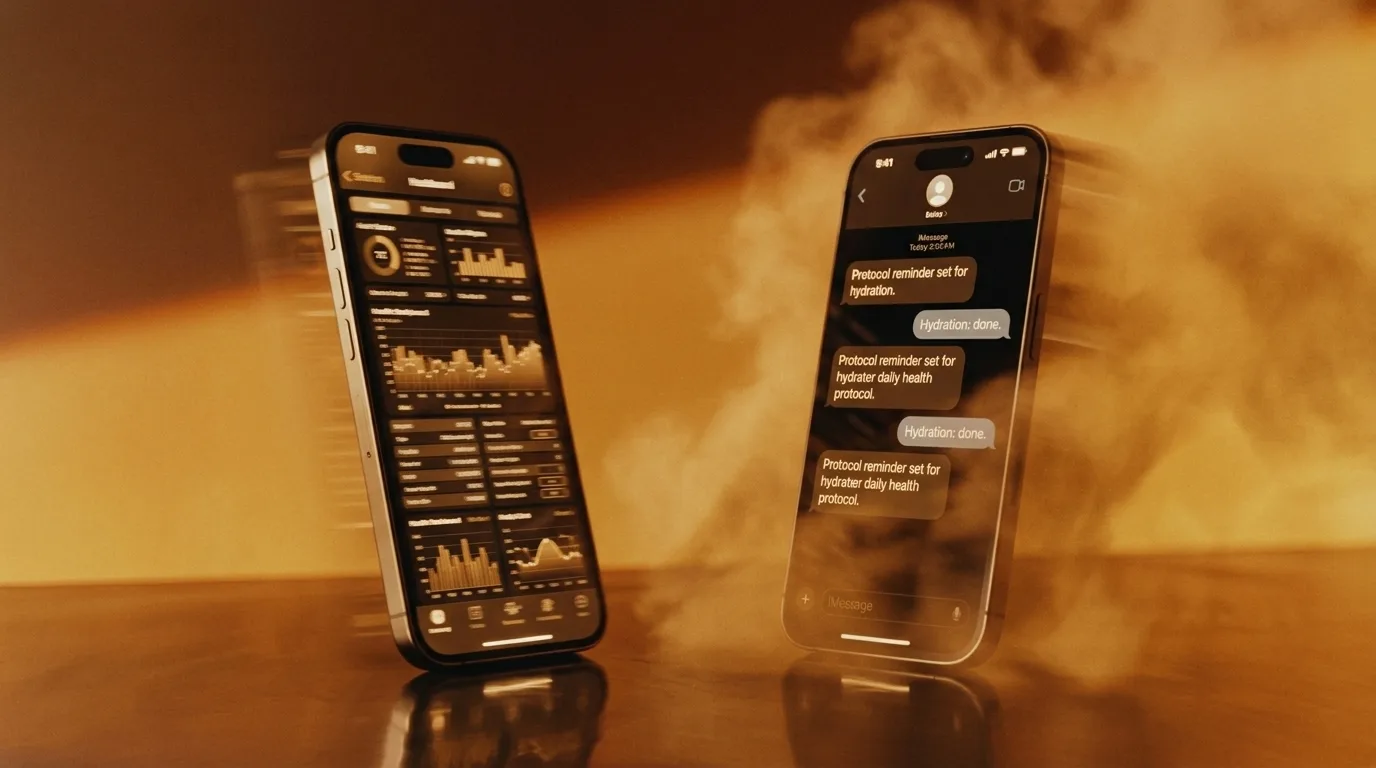
Overcoming the abandonment pattern documented by digital health researchers requires removing friction entirely. Instead of asking you to download another isolated app or navigate complex web portals, an agentic personal health assistant operates natively where you already communicate: inside iMessage and RCS. Rather than acting as a passive calculator, it works as a proactive concierge that automates daily health logistics.
When navigating intricate regimens involving GLP-1 compounds, recovery peptides, or longevity stacks, managing adherence manually is a constant failure point. Dedicated peptide tracker apps often demand tedious manual input for dosing units, vial volumes, and injection sites. A conversational assistant removes the interface burden instead, turning protocol tracking into a natural exchange of messages. You receive proactive daily reminders, confirm completed doses with a single tap or text, and log daily biometric sensations without opening a browser.
Anticipating protocol needs natively in messaging
The core distinction lies in proactive execution versus passive recording. Traditional portals wait for you to log in and upload data, while an agentic assistant monitors your background context and takes action. If your schedule changes or your wearable signals compromised recovery, your conversational assistant adapts your daily wellness plan instantly. It acts as an always-on executive assistant for your biology, ensuring consistency without draining your daily willpower.
- Conversational check-ins delivered via iMessage and RCS remove the need to open separate dashboards or web portals.
- Automated reminders keep complex peptide cycles, supplement stacks, and hydration targets strictly on schedule.
- Photo-based logging captures meal nutrition and macronutrient ratios without manual ingredient searching.
- Real-time adjustments modify workout intensity and recovery recommendations based on continuous biometric feedback.
A modern wellness assistant of this kind focuses on operational automation, biometric interpretation, and lifestyle optimization. It does not provide medical diagnoses or prescribe medications, so your personal protocols are executed smoothly alongside guidance from your licensed healthcare provider.
lab data automation
Diagnostic blood panels and biomarker assessments provide the objective roadmap for any serious longevity protocol. Yet the testing step is often where the workflow stops: Care Path Compare notes that with System Labs, baseline laboratory testing may be required depending on the treatment and clinician judgment, and that patients may use a local laboratory or get help coordinating it. Results then land in whatever format that laboratory provides, leaving patients with complex reference ranges that offer no direct connection to their daily meal choices, supplement timing, or training intensity.
Transforming diagnostic records into actionable lifestyle routines is where a dedicated personal health assistant changes the paradigm. By parsing biomarker telemetry instantly upon release, an automated assistant extracts key indicators such as fasting insulin, lipid subfractions, high-sensitivity C-reactive protein, and hormonal baselines. Instead of remaining locked in an unread portal file, this data dynamically recalibrates your active lifestyle protocols.
Bridging biomarker telemetry and continuous optimization
When biomarker telemetry is integrated directly into an automated messaging workflow, your health routine adapts dynamically. If baseline panels indicate elevated inflammatory markers or depleted micronutrient levels, your daily protocol updates automatically. Recommended recovery intervals extend, daily nutrition profiles shift to prioritize anti-inflammatory foods, and supplement schedules adjust to support biological equilibrium.
| Biomarker Variable | Static Telehealth Dashboard | Automated Biomarker Telemetry |
|---|---|---|
| Metabolic Markers (e.g. HbA1c, Fasting Glucose) | Delivered as a standalone lab report you interpret yourself | Instantly adjusts daily carbohydrate targets and meal timing recommendations |
| Inflammatory Indices (e.g. hs-CRP, Ferritin) | Reviewed only when a clinician follow-up is scheduled | Automatically scales back high-intensity training volume in favor of active recovery |
| Hormone Profiles (e.g. Free Testosterone, DHEA) | Reviewed periodically with delayed manual follow-up | Dynamically aligns sleep duration goals and evening wind-down protocols |
| Micronutrient Status (e.g. Vitamin D, Ferritin) | Requires manual purchase and tracking of individual supplements | Automatically updates daily supplement reminders to ensure targeted replenishment |
Connecting wearables for real-time execution
Biomarker testing reveals your baseline biology, but consumer wearables capture your dynamic physiological state every second. The primary bottleneck in digital wellness is data fragmentation. In an analysis of digital health architecture, Mindbowser emphasizes that fragmented, unstructured, and siloed data across disparate devices creates severe barriers to informed decision-making. When your sleep ring, smart watch, and fitness tracker operate in isolated silos, you are forced to manually interpret competing scores.
Unifying your telemetry into a centralized stream unlocks genuine health automation. By integrating your Apple Health data alongside continuous streams from WHOOP, Oura, Garmin, and Apple Watch, an agentic system synthesizes your biological readiness in real time. Instead of checking three separate dashboards every morning, your wearable data flows into an intelligent layer that decides what your body needs today.
Dynamic protocol adjustments based on recovery
Real-time wearable telemetry transforms how you manage physical output and recovery. When your overnight heart rate variability drops significantly and your resting heart rate spikes, your assistant recognizes systemic strain before you feel fatigued. Rather than adhering blindly to a rigid workout calendar, your daily schedule adjusts automatically to protect your muscle, energy, and hormonal drive.
- Unifies sleep architecture, recovery scores, and strain metrics across WHOOP, Oura, and Apple Health into a single context stream.
- Automatically detects compromised nervous system recovery and downgrades high-strain lifting sessions to low-impact mobility.
- Adjusts daily macronutrient and caloric recommendations dynamically based on total active energy expenditure and recovery strain.
- Enables you to automate daily routines so your fitness classes and recovery sessions schedule themselves around your peak biological windows.
Upgrading to friction-free messaging workflows
Choosing how to manage your health protocols comes down to an essential trade-off between administrative labor and effortless execution. Traditional telehealth services like System Labs provide the clinical consultations and pharmacy fulfillment necessary to obtain specialized therapies. Yet relying on static web dashboards leaves the heavy daily lifting on your shoulders. Layered on top of an already crowded day of decisions, manual logging, disjointed spreadsheets, and constant portal logins inevitably trigger burnout and protocol abandonment.
Reclaiming cognitive bandwidth with the miora Protocol
Upgrading to the miora Protocol replaces the friction of noisy dashboards with a dedicated concierge service operating natively in iMessage. By pairing an AI personal health assistant with access to dedicated human specialists, the miora Protocol protects your muscle, energy, and drive throughout active GLP-1 and peptide regimens. Your assistant monitors your wearable telemetry 24/7, tracks daily adherence, and handles the logistics of your routine, while clinical specialists remain in the loop to guide your journey.
| Workflow Dimension | Manual Telehealth Dashboards | miora Protocol Concierge |
|---|---|---|
| Interface Experience | Fragmented mobile apps and desktop web browser portals | Frictionless, conversational messaging natively via iMessage and RCS |
| Protocol Adherence | Manual logging prone to the 70% 100-day drop-off rate | Proactive daily check-ins and one-tap adherence verification |
| Wearable Integration | Isolated device silos requiring manual interpretation | Unified real-time telemetry from Apple Health, WHOOP, and Oura |
| Operational Execution | Static reminders with no real-world automated actions | Automates class booking, macro alignment, and recovery planning |
| Support Model | Asynchronous support tickets with delayed portal responses | Dedicated concierge support with specialists guiding your protocol |
Health optimization should empower your lifestyle, not consume your mental energy. By shifting from passive tracking to proactive automation, you eliminate decision fatigue and ensure consistency in your longevity protocols, so the protocol runs even on the days your willpower does not.