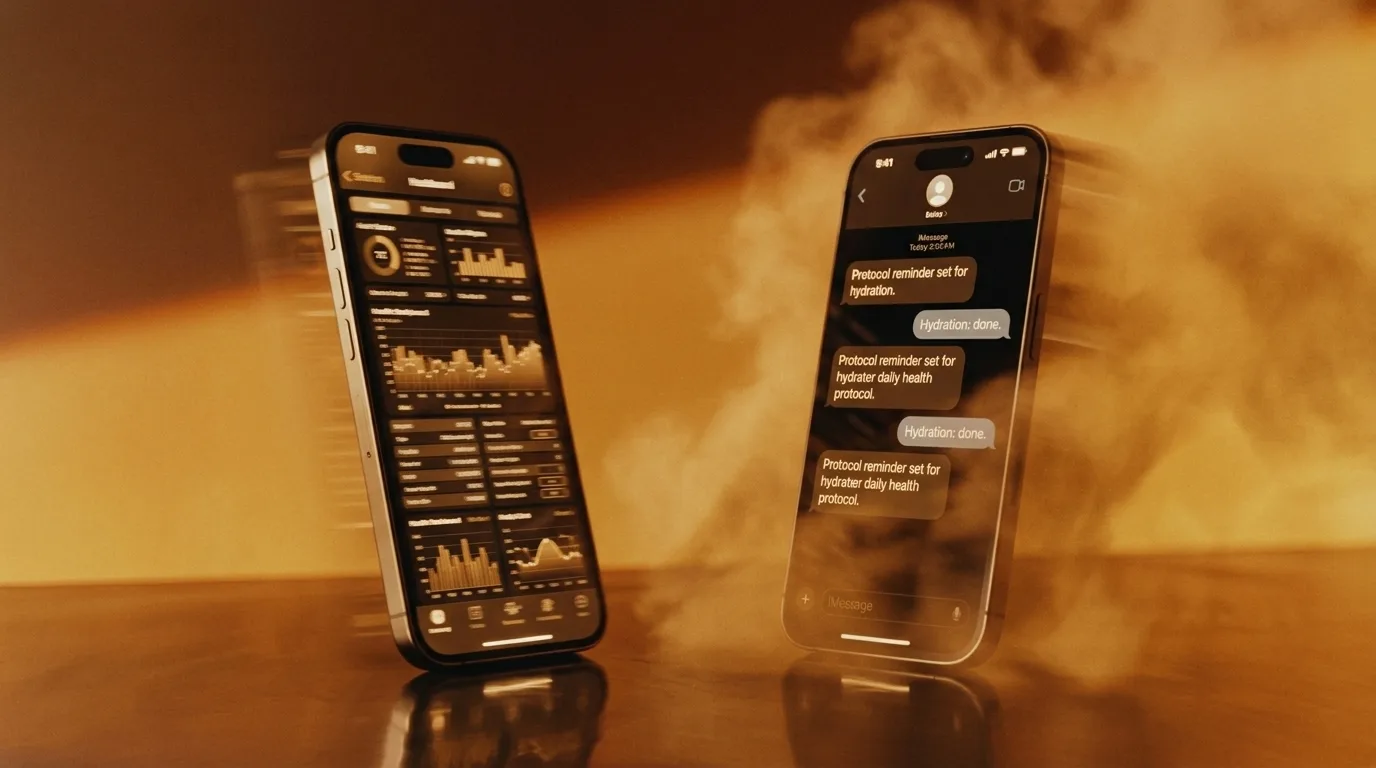
The decision fatigue of standalone peptide apps
Managing a sophisticated peptide stack or GLP-1 regimen often begins with high motivation, but the daily cognitive overhead quickly accumulates. Healthmaxxers and longevity enthusiasts frequently juggle multiple compounds, staggered dosing schedules, reconstitution calculations, and injection site rotations. When every single data point requires manual entry into a standalone smartphone application, health optimization begins to feel like an unpaid administrative job.
The hidden cost of manual dose logging
Traditional mobile utilities force users to navigate through multi-layered menus simply to record a single morning dose or note an injection site. You have to open a dedicated app, tap through several screens, select compound concentrations, calculate syringe units, and confirm timestamps. Over a standard cycle, repeating this sequence multiple times per day creates friction that drains willpower, leading to missed entries, incomplete data logs, and tracking burnout.
- Manual calculation of reconstitution ratios and syringe unit conversions for each vial
- Navigating siloed dashboards to log injection sites, timestamps, and dosages
- Entering subjective symptom scores across fragmented forms and drop-down menus
- Delayed or forgotten logging caused by the friction of opening separate apps throughout the day
A systematic review and meta-analysis in the Journal of Medical Internet Research found a pooled dropout rate of 43% across app-based interventions for chronic disease, rising to 49% in real-world observational studies. Relying on sheer discipline to sustain detailed logs across separate peptide tracker apps creates an inherent design flaw that compromises protocol consistency.
Pepty app comparison: manual logging versus automation
Standalone utilities like the Pepty app are structured around isolated mobile environments. They provide digital interfaces to replace spreadsheets and paper notebooks, offering calendar views, reminders, and educational quizzes to guide users through their routines. However, the operational model remains fundamentally passive: the software waits for the user to initiate contact, input data, and interpret trends manually.
Static data storage versus real-time action
While a dedicated portal can organize compound names and cycle lengths, it treats health metrics as static database records rather than dynamic lifestyle variables. Bite-sized educational modules and scheduled push notifications may prompt engagement, but they do not eliminate the burden of manual logging. If your sleep is disrupted or your recovery score drops, a static portal cannot adjust your daily training schedule or coordinate your recovery logistics.
| Capability | Standalone Utility (e.g. Pepty) | Automated Health Assistant |
|---|---|---|
| Interface Architecture | Isolated native mobile app portal | Conversational interface via iMessage and RCS |
| Dose Logging Method | Manual navigation across menus and form fields | Frictionless text confirmation in existing chats |
| Lifestyle Integration | Siloed database with no calendar or service hooks | Automated coordination with wearables and schedules |
| Protocol Feedback | Static educational quizzes and fixed reminders | Proactive, context-aware lifestyle recommendations |
Reviews of mobile health interventions reach a blunt conclusion: sustained use is the exception rather than the rule. A literature review of 62 mHealth app studies found that for any given participant it is more likely that they will not be retained than that they will be, and that roughly 71% of app users disengage within 90 days of starting a new activity. Tracking portals that depend on continuous self-reporting without delivering automated real-world action are fighting that baseline.
Pep AI comparison: tracking features versus a health agent
Pep AI provides an extensive feature set designed for peptide and GLP-1 users, incorporating reconstitution calculators, compound inventory vaults, and tracking modules for over 15 distinct symptoms. It serves as an all-in-one digital binder for logging water intake, macro goals, sleep duration, and progress photos within an iOS environment.
The friction of multi-parameter manual data entry
Despite the breadth of these features, the user remains responsible for manually capturing every single data point. Logging 15 different side-effect severities, snapping meal photos to populate macro rings, and manually reviewing sleep heatmaps across separate app screens requires significant daily effort. Storing vast amounts of self-reported data in an app does not translate into automated support when you are managing complex compound schedules.
- Manual grading of 15+ individual symptom severities across separate tracking tabs
- Snapping and reviewing food photos to manually adjust daily macronutrient rings
- Navigating isolated inventory vaults to check vial counts and reorder dates
- Reviewing static pharmacokinetic half-life estimations without automated schedule adjustments
Instead of turning the user into a full-time data entry clerk, modern health automation systems eliminate manual logging by operating as intelligent agents that continuously interpret background data and streamline protocol adherence.
Wearable telemetry and the end of manual inputs
The shift from passive logging to proactive optimization is driven by continuous wearable telemetry. High-frequency biometric sensors on wristbands and smart rings continuously measure autonomic nervous system markers, cardiovascular strain, and sleep staging. These objective data streams provide a granular, continuous picture of physiological state without requiring a single manual entry from the user.
Replacing subjective recall with objective biometrics
Subjective self-reporting in mobile health tracking is undermined by recall bias, imprecise timing, and compliance that fades as a study runs on, whereas continuous wearable monitoring captures physiological state unobtrusively and without user effort. Rather than asking users to score their energy or stress on a subjective 1-to-10 scale, connected systems analyze real-time physiological signals directly.
- Continuous resting heart rate (RHR) trends to detect underlying systemic strain
- Heart rate variability (HRV) telemetry to assess autonomic recovery and sympathetic balance
- Objective sleep architecture metrics (REM, deep, light sleep) instead of manual sleep logs
- Skin temperature and cardiovascular recovery curves to identify protocol adaptations
By connecting continuous biometric data from Apple Health and WHOOP integrations, an automated health assistant can interpret physiological trends in the background and proactively adapt your recovery and training intensity.
Why peptide cycles require clinician oversight
Peptide protocols and metabolic modulators operate on delicate endocrine and cellular pathways. Typical cycles range from 4 to 8 weeks, requiring careful calibration of compound stacks, receptor sensitivity monitoring, and structured off-cycle phases. Attempting to manage multi-compound protocols without clinical guidance introduces serious risks of hormonal imbalance and unmonitored physiological stress.
Managing risk across compound cycles
When biohackers navigate compounded peptide stacks through standalone apps, they operate without a safety net. An app might store your dose logs, but it cannot evaluate whether elevated resting heart rate or gastrointestinal distress warrants an immediate protocol adjustment or clinical follow-up. Ensuring protocol safety requires continuous human clinical expertise integrated directly into the monitoring loop.
| Protocol Dimension | Standalone Logging App | Clinician-Guided Concierge Model |
|---|---|---|
| Medical Guidance | Explicitly excludes medical advice and clinical oversight | Licensed clinicians review bio-data and protocol progress |
| Adverse Event Detection | User manually logs symptoms into unmonitored charts | Real-time flags alert specialists when biometrics deviate |
| Cycle Adjustments | User must research and calculate changes independently | Clinicians provide personalized guidance on dosing and cycling |
| Safety Architecture | Informational and record-keeping utility only | Clinician-in-the-loop oversight to protect health outcomes |
Standalone peptide and GLP-1 logging utilities are consumer record-keeping tools by design: they store what you type in and surface it back to you, without any clinical evaluation, diagnosis, or medical supervision attached. A guided concierge model bridges this critical gap by ensuring experienced clinicians oversee the protocol at every stage.
The shift from dedicated app portals to iMessage
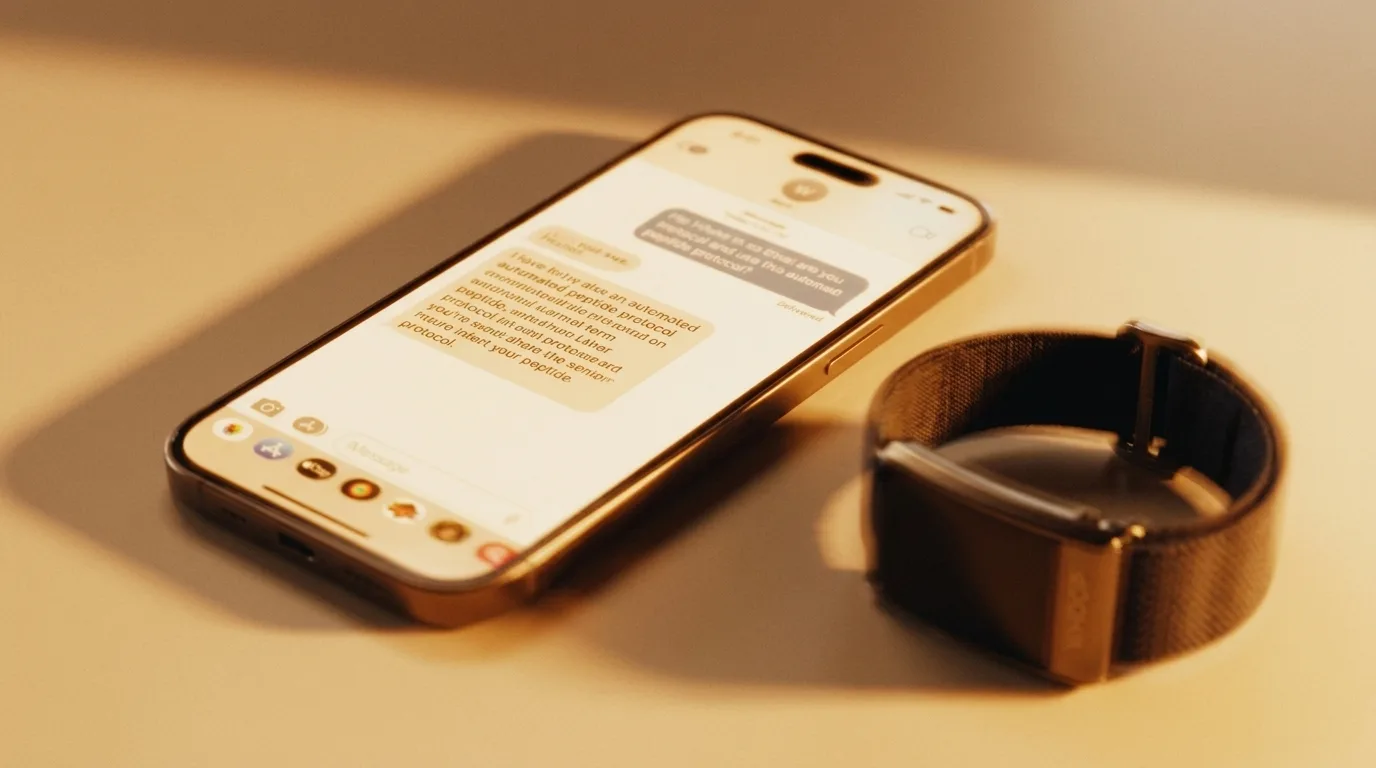
The friction of downloading, updating, and navigating native mobile apps is a major driver of tracking abandonment. Every extra portal installed on a smartphone adds visual clutter, notification fatigue, and interface complexity. High performers do not need another siloed dashboard; they need health optimization integrated directly into the communication channels they already use all day.
Conversational interfaces and adherence velocity
Text messaging clearly moves the needle for some people, but not reliably on its own: a Cochrane review of randomised trials of text messaging for medication adherence in cardiovascular secondary prevention concluded the evidence was very uncertain, with only 10 of 18 studies showing a benefit for adherence compared with usual care, and reviewers note that simple reminders work best when they are tailored and interactive rather than generic. Moving protocol management into text conversations removes the psychological resistance of opening standalone apps, and pairing it with automated data and human oversight is what turns a reminder into support.
- Zero app-switching overhead by operating inside existing messaging apps
- Natural language dose logging: reply with a quick text to confirm administration
- Proactive check-ins delivered directly to your lock screen via iMessage and RCS
- Instant conversational answers without digging through nested app navigation bars
Operating natively within iMessage transforms protocol tracking from a labor-intensive chore into an effortless two-second text exchange, maintaining high adherence without decision fatigue.
Automating your stack with a concierge protocol
For individuals seeking an effortless, fully guided experience, a concierge membership eliminates the friction of standalone apps. Instead of forcing you to navigate noisy dashboards and manually log dozens of data points, this model combines conversational AI automation with clinical oversight inside your daily text messages.
Daily protocol support with specialist access
Operating as a proactive AI personal health assistant via iMessage and RCS, the service integrates directly with your wearable devices, including WHOOP, Oura, and Apple Health. It monitors your biometric telemetry 24/7, interprets physiological trends in real time, and handles the logistics of your wellness routine so you can focus on thriving.
- Daily conversational check-ins via iMessage and RCS to track dose adherence and timing
- Real-time side-effect monitoring with clinician-in-the-loop oversight to ensure protocol safety
- Direct access to a dedicated specialist via text to answer protocol and compound questions
- Automated wearable integration that tracks HRV, sleep, and recovery without manual logging
- Proactive adjustments to workout schedules and recovery protocols to protect muscle, energy, and drive
As an agentic health assistant and concierge wellness service, miora handles the heavy lifting of daily protocol tracking while keeping expert human specialists in the loop, ensuring your health optimization routine remains completely seamless and protected.