
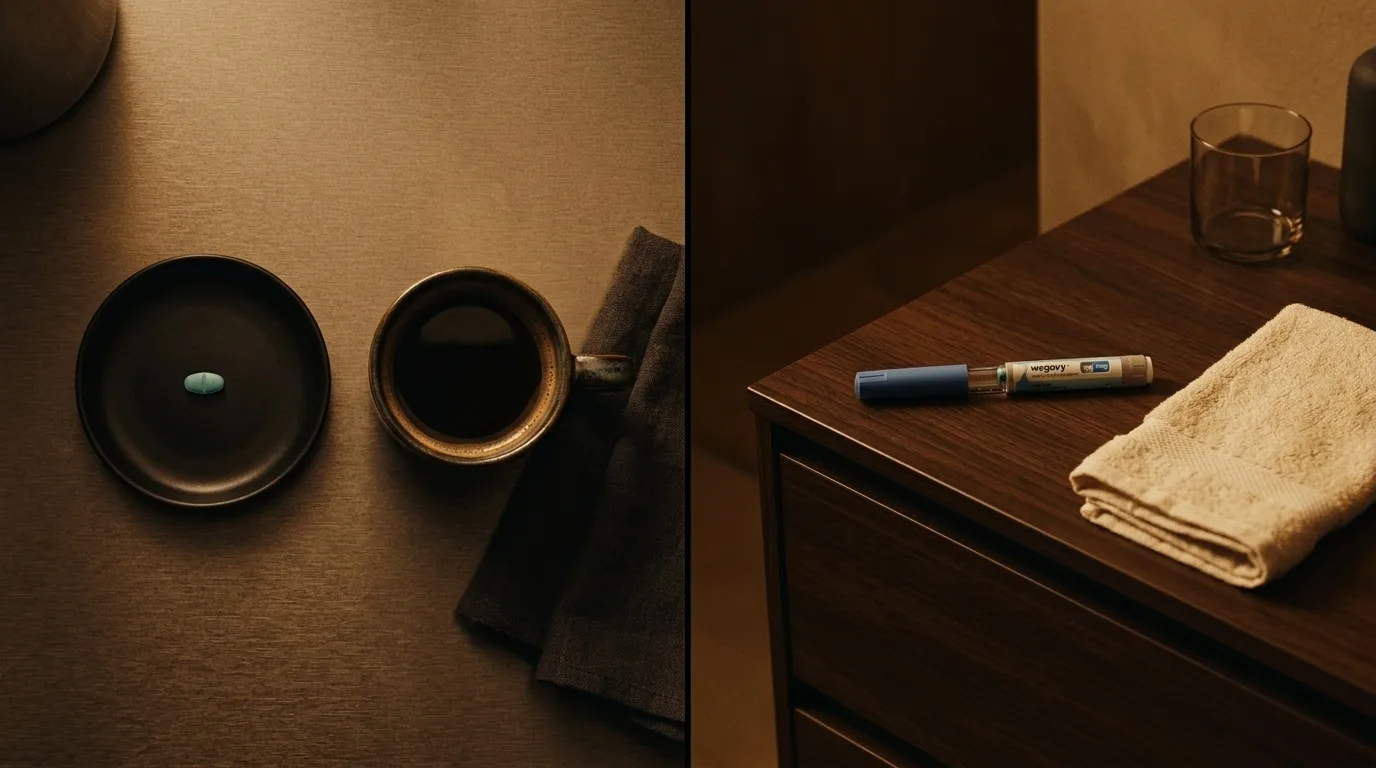
rybelsus vs wegovy
Choosing the right delivery vehicle for a GLP-1 receptor agonist fundamentally reshapes your daily operational bandwidth. Both Rybelsus and Wegovy share the exact same active peptide backbone, semaglutide, but they are engineered for entirely different clinical indications, pharmacokinetics, and daily routines. is formulated as a once-weekly subcutaneous injection specifically approved for chronic weight management, whereas Rybelsus is a daily oral tablet designed primarily for glycemic control in type 2 diabetes.
The core engineering challenge with oral peptides is gastric degradation. To survive the stomach’s acidic environment and proteolytic enzymes, Rybelsus co-formulates semaglutide with 300 mg of sodium N-(8-[2-hydroxybenzoyl] amino) caprylate (SNAC). This absorption enhancer creates a localized, transient increase in gastric pH, enabling a tiny fraction of the intact peptide to diffuse across the gastric epithelium. In contrast, subcutaneous injection bypasses the entire gastrointestinal tract, delivering systemic bioavailability with near-total efficiency.
| Dimension | Rybelsus (Oral Semaglutide) | Wegovy (Subcutaneous Semaglutide) |
|---|---|---|
| Primary Indication | Type 2 diabetes glycemic management, plus cardiovascular risk reduction in high-risk adults with type 2 diabetes | Chronic weight management alongside a reduced-calorie diet and increased physical activity |
| Dosing Frequency | Once daily on an empty stomach in the morning | Once weekly, same day each week, at any time of day |
| Maximum Top Dose | 14 mg once daily tablet | 2.4 mg once weekly maintenance dose in adults |
| Absorption Technology | Co-formulated with the absorption enhancer SNAC | Direct subcutaneous absorption |
| Administration Friction | No food, drink or other oral medication for at least 30 minutes after dosing | Can be taken with or without meals |
Because the oral absorption pathway is vulnerable to gastric contents, daily dosage requirements for Rybelsus (up to 14 mg daily) are substantially higher than the weekly dose of Wegovy (up to 2.4 mg weekly). For health optimizers and busy professionals managing intense schedules, understanding these mechanical differences is essential before locking in a protocol.
oral glp-1 timing
The absorption window for oral semaglutide is unforgiving. Unlike standard small-molecule oral medications that can be taken with food, the SNAC carrier technology in Rybelsus requires strict adherence to precise biological parameters. Clinical pharmacokinetic studies show that when semaglutide is ingested in a fed state, systemic exposure is severely blunted or completely unmeasurable.
To ensure therapeutic peptide levels enter circulation, three non-negotiable administration rules dictate every single morning:
- Take the tablet immediately upon waking on an empty stomach with a completely clear overnight fast.
- Swallow the pill whole with no more than 4 ounces (120 mL) of plain water, as excess liquid accelerates gastric emptying into the small intestine before absorption can occur.
- Maintain a strict minimum fasting window of 30 minutes before consuming any food, coffee, tea, supplements, or other oral medications.
The instructions are explicit: take the tablet on an empty stomach in the morning with no more than 4 ounces of plain water, and wait 30 minutes before eating, drinking, or taking other oral medications, vitamins, or supplements. Waiting less than 30 minutes decreases how much semaglutide is absorbed, which is why the PIONEER trials standardised exactly this dosing procedure across every study arm. For high-performing individuals who rely on structured morning rituals, this protocol introduces a fixed 30-minute operational delay before daily nutrition or cognitive enhancers can begin.
rybelsus daily routine
Translating strict pharmacokinetics into a high-tempo professional schedule often reveals friction. If your morning involves an early workout, quick breakfast, or immediate double espresso, a 30-minute forced fasting block forces a complete restructuring of your morning sequence. Missing this window or rushing your morning coffee blunts the peptide’s effectiveness and wastes active compound.
Managing this daily routine requires strategic habit sequencing to eliminate decision fatigue while protecting digestive comfort:
- Bedside placement: Keep the Rybelsus blister pack and a measured 4-ounce glass of water directly on your nightstand to dose the exact second your alarm sounds.
- Workout buffering: Use the 30-minute fasting window for mobility work, breathwork, or your commute, delaying your pre-workout hydration and fuel until the absorption timer clears.
- Caffeine scheduling: Shift your primary caffeine intake to arrive 45 to 60 minutes after dosing to ensure the SNAC mechanism has finished its transcellular transport across the stomach wall.
- Nausea mitigation: Avoid rushing high-fat breakfasts immediately at the 30-minute mark; break your fast with light hydration and lean protein to prevent sudden gastric distress.
While daily oral dosing eliminates needle anxiety entirely, it introduces daily cognitive load. You must execute the exact same mechanical sequence 365 mornings a year without deviation.
wegovy weekly injection routine
In contrast to the rigid morning choreography of oral semaglutide, the weekly subcutaneous Wegovy protocol eliminates daily friction. A single subcutaneous injection once every seven days delivers the entire therapeutic payload into the subcutaneous adipose tissue of your abdomen, thigh, or upper arm, where it forms a slow-release depot.
Because the injection delivers semaglutide directly into systemic circulation, it is completely decoupled from your digestive tract. The prescribing information directs you to inject once weekly on the same day each week, at any time of day, with or without meals, and notes that the time of day and the injection site can be changed without a dose adjustment.
| Protocol Feature | Daily Oral (Rybelsus) | Weekly Subcutaneous (Wegovy) |
|---|---|---|
| Execution Frequency | One tablet every day | One injection on the same day each week |
| Meal & Drink Coordination | At least 30 minutes with no food, beverages or other oral medications | With or without meals |
| Timing Flexibility | Morning only, on an empty stomach | Any time of day, and the time can be changed without a dosage change |
| Travel Logistics | Daily pill blister pack tracking | Single weekly pen or pre-filled syringe |
For busy executives and frequent travelers, shifting from daily dosing to a weekly injection replaces constant morning tracking with a single, scheduled weekly checkpoint, freeing up cognitive bandwidth for high-leverage work.
satiety and weight loss results
Beyond morning logistics, the clinical efficacy and satiety profiles between the two formulations diverge significantly. In the landmark STEP 1 trial published in the New England Journal of Medicine, adults taking once-weekly subcutaneous semaglutide 2.4 mg achieved a mean body weight reduction of 14.9% at week 68, compared to just 2.4% in the placebo group. This robust systemic exposure consistently silences food noise across the entire seven-day cycle.
By comparison, the PIONEER clinical trial program evaluating daily oral semaglutide at the maximum approved 14 mg dose demonstrated an average body weight loss of about 4 kg after 26 weeks in type 2 diabetes cohorts, with placebo-adjusted differences of roughly 2 kg. While Rybelsus delivers meaningful glycemic control and modest appetite suppression, its lower systemic bioavailability yields a gentler reduction in food noise compared to full-dose Wegovy.
- Appetite suppression depth: Wegovy provides profound, continuous central satiety signaling that significantly reduces overall caloric drive.
- Day-to-day consistency: Rybelsus experiences higher intra-individual exposure variability based on daily gastric emptying rates, creating occasional fluctuations in daily hunger suppression.
- Clinical goal alignment: Healthmaxxers targeting substantial metabolic recalibration typically lean toward weekly injections, while those seeking mild appetite moderation without needles often prefer oral dosing.
Understanding this difference in potency prevents unrealistic expectations: a 14 mg daily oral tablet is not the pharmacokinetic equivalent of a 2.4 mg weekly injection.
managing glp-1 side effects
Because both formulations activate GLP-1 receptors in the gut and brain stem, they share a common side-effect spectrum dominated by transient nausea, altered bowel habits, and delayed gastric emptying. Navigating these nausea curves requires deliberate nutritional architecture rather than reactive coping.
When appetite drops dramatically, the primary biological risk is unintentional lean tissue loss. To protect lean muscle and preserve metabolic rate during rapid fat loss, maintaining high-density protein intake is critical. Grounded in sports nutrition meta-analyses, target a daily protein threshold of 1.6 to 2.2 grams per kilogram of body weight.
- Front-load essential amino acids: Prioritize easily digestible liquid or semi-solid protein sources (whey isolate, egg whites, Greek yogurt) during windows of peak appetite.
- Electrolyte and fluid protocols: Delayed gastric emptying blunts thirst signaling; track daily fluid intake and supplement sodium, potassium, and magnesium to prevent fatigue and headaches.
- Resistance training stimulus: Perform progressive resistance training 3 to 4 times weekly to signal muscle protein synthesis and prevent sarcopenic lean mass wasting.
- Wearable telemetry tracking: Monitor resting heart rate and Heart Rate Variability (HRV) on your WHOOP or Oura to gauge autonomic stress and adjust training strain accordingly.
Treating your GLP-1 regimen as an integrated metabolic protocol rather than an isolated medication ensures you drop visceral fat while keeping your muscle, energy, and hormonal drive protected.
automating your protocol
Balancing strict medication windows, macro splits, hydration curves, and strength sessions quickly turns health optimization into an exhausting second job. High-performing professionals do not fail their protocols because of a lack of discipline; they fail because fragmented dashboards and endless manual tracking create decision fatigue.
This is where miora shifts your routine from manual labor to proactive automation. Rather than forcing you to log meals in clunky apps or calculate injection half-lives in spreadsheets, it acts as an AI personal health assistant operating natively through iMessage and RCS, connecting with WHOOP, Oura, Apple Health, and ClassPass and interpreting your real-time biometric telemetry to make daily decisions effortless.
- Automated routine timing: a text-based assistant can manage your morning fasting timers, injection reminders, and hydration benchmarks without manual alarms.
- Biometric-driven adjustments: when your wearable reveals depressed HRV or poor recovery, training targets are adjusted automatically and restorative protocols are flagged.
- Concierge guidance: a membership tier adds daily check-ins, macro adherence tracking, and direct access to dedicated protocol specialists.
As an agentic wellness product, miora handles the heavy lifting so you can stay consistent without the cognitive friction. While miora does not provide medical diagnoses or replace your prescribing physician, it ensures your daily execution remains airtight. Try miora to turn fragmented data into automated, thriving daily performance.