glp-1 baseline metrics
Stepping into a GLP-1 protocol without establishing your biometric telemetry first is like tuning an engine without a dyno run. For healthmaxxers and longevity enthusiasts, peptides like semaglutide and tirzepatide represent powerful metabolic levers. Yet starting Day 1 without clean pre-protocol data leaves you unable to distinguish between genuine metabolic adaptation and systemic stress.
Core Biomarker Pillars for Protocol Readiness
Establishing your biological baseline requires a minimum of 14 to 30 days of continuous data capture before taking your first dose. This telemetry establishes the reference envelope for your autonomic nervous system, nocturnal cardiovascular recovery, and tissue composition. When medication titration begins, these baselines allow you to track subtle physiological shifts in real time rather than guessing from subjective symptoms.
- Cardiovascular Strain: Establishing a clean 30-day baseline for nocturnal resting heart rate (RHR) to gauge autonomic tone.
- Autonomic Balance: Tracking nightly heart rate variability (HRV via RMSSD) to monitor parasympathetic activity and systemic recovery capacity.
- Tissue Distribution: Documenting baseline lean mass and visceral adipose tissue to ensure weight loss comes from fat rather than functional muscle.
- Sleep Architecture: Logging deep and REM sleep duration alongside sleep efficiency to catch early sleep fragmentation during initial titration.
Real-world wearable data confirms that GLP-1 initiation induces measurable physiological responses across cardiovascular and autonomic streams, with resting heart rate rising and heart rate variability falling over the first 12 weeks of therapy. Without an accurate pre-treatment reference point, isolating medication effects from external lifestyle variables becomes nearly impossible.
preparing for glp-1 consult
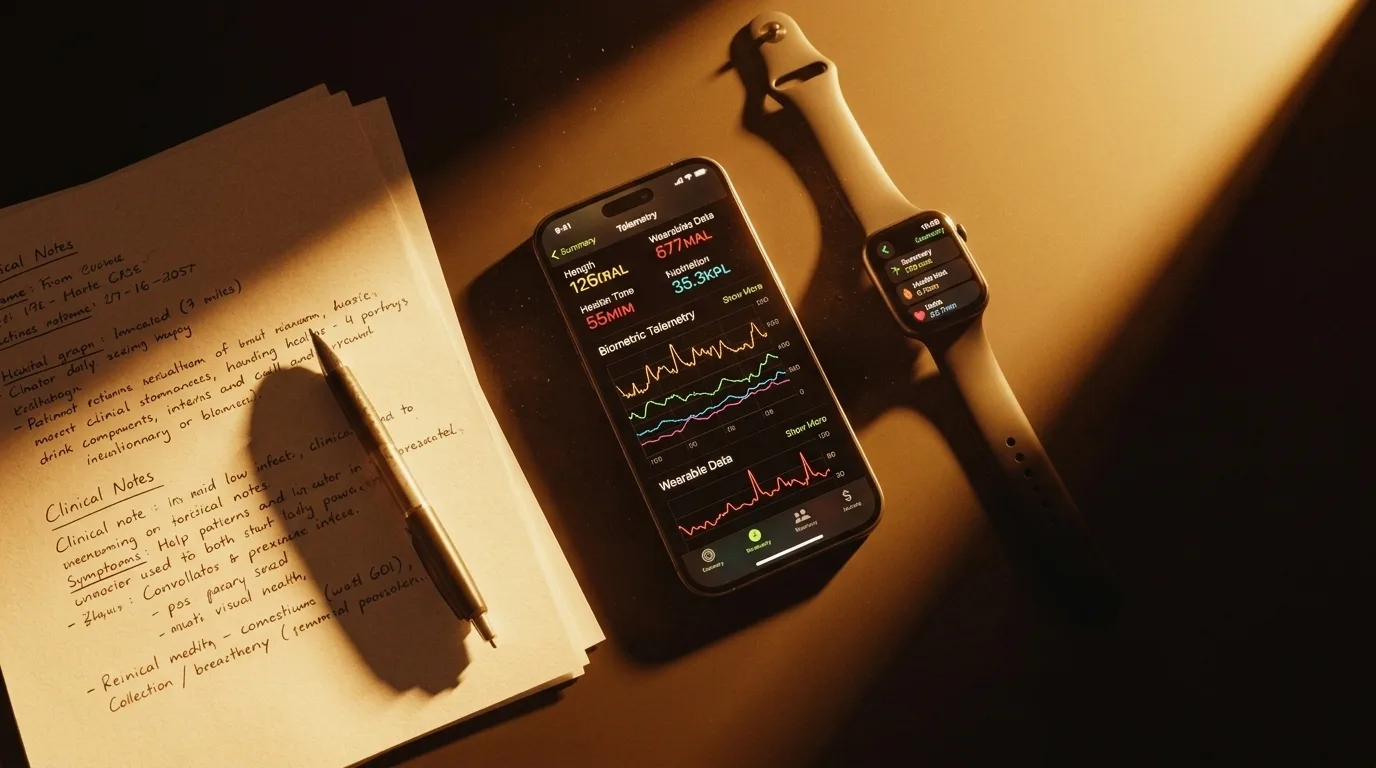
Your initial consultation sets the trajectory for your entire protocol. Walking into your prescriber appointment with structured bio-data transforms the conversation from a standard intake into a tailored optimization strategy. Instead of relying on vague recollections, presenting clean telemetry allows your clinician to calibrate titration pacing specifically to your physiological profile.
Assembling the Pre-Consultation Dossier
A high-fidelity intake dossier pairs wearable metrics with comprehensive clinical bloodwork. Baseline panels before a GLP-1 prescription typically cover liver function (ALT, AST), kidney function (creatinine, eGFR), and glycemic markers (fasting glucose, HbA1c), alongside thyroid, lipids, and a complete blood count. Pairing these lab markers with objective sleep and activity averages gives your care team a complete picture of your metabolic health. Those seeking tailored guidance can also schedule a longevity consultation to review their baseline panels before their initial prescriber appointment.
| Data Category | Primary Metric | Baseline Window | Consultation Utility |
|---|---|---|---|
| Autonomic Recovery | Nocturnal HRV (RMSSD) | 30-day rolling average | Identifies baseline stress tolerance and recovery capacity |
| Cardiovascular | Nocturnal Resting Heart Rate | 30-day rolling average | Establishes benchmark for expected post-initiation chronotropic shift |
| Glycemic Control | HbA1c & Fasting Glucose | Drawn before your first dose | Provides clinical context for metabolic sensitivity |
| Body Composition | DEXA Lean Mass & VAT | Before first dose, or about two weeks after starting | Sets structural target to prevent sarcopenic lean tissue loss |
Organizing these variables into a unified summary saves valuable appointment time, ensuring your clinician focuses on protocol customization, hydration strategies, and side-effect mitigation from day one.
wearable tracking glp-1
Continuous biometric monitoring eliminates the friction and inaccuracies of manual health logging. Modern consumer wearables, including WHOOP, Oura, and Apple Watch, capture continuous photoplethysmography (PPG) signals while you sleep, providing an objective window into systemic recovery without requiring conscious user input.
Hardware Precision and Nocturnal Signal Detection
Nocturnal telemetry is the gold standard for protocol tracking because sleep eliminates daytime confounding variables such as postprandial spikes, caffeine intake, acute training stress, and cognitive load. Capturing autonomic signals across consistent sleep cycles enables reliable day-over-day trend analysis.
- WHOOP: Excels at capturing continuous strain, cardiovascular recovery, and nocturnal respiratory rate with high sampling frequency.
- Oura Ring: Delivers high-fidelity nocturnal temperature deviation tracking, sleep staging, and resting cardiovascular metrics.
- Apple Watch: Integrates comprehensive daytime cardiovascular monitoring, ECG functionality, and deep integration with Apple Health data flows.
Pairing automated wearable streams with dedicated side effect tracking provides a real-time safety harness during the critical 12-week titration ramp.
Heart Rate and Cardiovascular Telemetry
One of the most predictable physiological shifts following GLP-1 initiation is a change in resting cardiovascular dynamics. GLP-1 receptors are expressed directly in cardiac tissue, specifically within the sinoatrial node. Activating these receptors produces a direct chronotropic response, resulting in a measurable elevation in resting heart rate.
Quantifying Autonomic Shifts and Sinoatrial Response
In a real-world wearable cohort study using propensity matching and causal inference, initiating a GLP-1 receptor agonist produced a resting heart rate 3.2 beats per minute higher than matched controls at week 12 of therapy. That chronotropic shift was mediated by a concurrent reduction in heart rate variability, with RMSSD running 6.2 ms lower than controls.
| Cardiovascular Metric | Baseline Expectation | Typical 12-Week Shift | Protocol Action Threshold |
|---|---|---|---|
| Resting Heart Rate | Individual 30-day baseline | +3.2 bpm vs. matched controls | Sustained rise >10 bpm above baseline warrants clinician review |
| Heart Rate Variability | Baseline RMSSD range | -6.2 ms in RMSSD vs. matched controls | Persistent suppression prompts recovery and sleep optimization |
| Respiratory Rate | 12 to 20 breaths/min | No consistent medication-driven shift reported | Abrupt elevation signals potential dehydration or systemic stress |
Understanding this expected cardiovascular shift in advance prevents unnecessary anxiety. When your wearable reflects a 3 bpm bump in resting heart rate during week four, your baseline telemetry confirms that this is a recognized pharmacological mechanism rather than an acute overtraining signal.
Lean Body Mass and Composition Tracking
The primary objective of any peptide or metabolic protocol is optimizing body composition, not merely dropping gross scale weight. Standard bathroom scales provide a single aggregate number that obscures whether weight loss is driven by visceral fat reduction, fluid shifts, or skeletal muscle catabolism.
Safeguarding Skeletal Muscle and Metabolic Rate
Clinical trial data and DEXA substudies reveal that approximately 25% to 45% of total weight lost during GLP-1 therapy can come from lean mass if dietary protein and resistance training are not strictly maintained. In semaglutide trials, participants in the DEXA substudy lost an average of 5.8 kg of lean mass over 68 weeks. Protecting this metabolically active tissue is vital for sustaining resting energy expenditure and long-term vitality.
| Assessment Method | Accuracy Level | Cadence | Primary Telemetry Target |
|---|---|---|---|
| Dual-Energy X-ray Absorptiometry (DEXA) | Clinical Gold Standard | Baseline before first dose, then follow-up scans every 3 to 6 months during active weight loss | Total lean mass, appendicular lean index, visceral fat |
| Segmental BIA Smart Scale | Trend Analysis Reference | 2-4 times weekly | Rolling fat mass vs. skeletal muscle trend vector |
| Body Circumference Metrics | Practical Structural Check | Bi-weekly | Waist-to-hip ratio and structural limb girth |
To prevent lean tissue degradation, anchoring a clinical DEXA baseline with daily home tracking from a smart scale allows you to spot negative body composition trajectories early. Combining this objective data with targeted protocols to protect lean muscle ensures that weight lost consists almost entirely of adipose tissue.
Defeating Tracking Exhaustion Through Automation
The modern biohacker often faces an unexpected burden: tracking exhaustion. Managing a complex health stack across multiple wearables, smart scales, meal logging apps, and lab portals quickly turns health optimization into a labor-intensive second job. When biological data remains trapped in fragmented silos, decision fatigue inevitably sets in.
Consolidating Disparate Biological Data Streams
The solution to tracking fatigue is not more willpower or more complex spreadsheets; it is intelligent automation. Instead of spending cognitive energy reviewing disjointed dashboards every morning, your biometric streams should automatically synchronize, interpret trends, and adjust your daily protocol without manual intervention.
- Unified Ingestion: Aggregating raw data streams from WHOOP, Oura, and smart scales into a consolidated metabolic picture.
- Noise Filtering: Automatically converting volatile daily scale readings into reliable smoothed weight trends to eliminate emotional reactivity.
- Proactive Adaptation: Adjusting daily training volume and recovery targets based on continuous autonomic telemetry.
Eliminating manual data entry frees your mental bandwidth, allowing you to focus on executing your protocol rather than managing its administrative overhead.
Transitioning From Baseline to Active Protocol Management
Establishing your pre-treatment baseline is the foundation of a successful GLP-1 journey, but long-term success requires seamless ongoing execution. Moving from static baseline metrics to dynamic protocol management requires an intelligent layer that continuously analyzes your telemetry and takes action on your behalf.
Proactive Concierge Support for Active Cycles
This is where an always-on interpretation layer changes your health operating system. Rather than leaving you to decode complex wearable dashboards alone, an agentic personal health assistant can operate natively through iMessage and RCS. It connects directly to your wearables, tracks your recovery, and manages the logistical heavy lifting of your protocol.
For individuals undergoing active GLP-1 or peptide regimens, the miora Protocol provides dedicated concierge support. By pairing continuous bio-data interpretation with clinicians in the loop, daily check-ins, and automated protocol adjustments, it safeguards your lean mass, monitors cardiovascular shifts, and keeps your energy protected throughout your entire cycle.
- Always-On Telemetry Interpretation: Continuous 24/7 background monitoring of resting heart rate, HRV, and sleep recovery trends.
- Frictionless Communication: Real-time protocol guidance, side-effect logging, and habit tracking directly inside your messaging app.
- Clinician-in-the-Loop Safeguards: Personalized guidance tailored to your individual baseline metrics, ensuring proactive and safe protocol execution.
By replacing fragmented tools and manual tasks with proactive automation, miora ensures your biological optimization runs effortlessly in the background, allowing you to thrive throughout your health journey.